Harvest Lane Culinary Village and Urban Winery
Napa, California
A vibrant locals-first food and wine campus near downtown Napa.
Combining winery margins with food hall traffic.
Investment Overview
Richard Cardoza – March 2026
HARVEST LANE CULINARY VILLAGE - Napa, California
MANAGEMENT & ORIGIN: The Proven Catalyst
Harvest Lane Culinary Village is led by Richard Cardoza, a 30-year veteran of the fine wine, spirits, and hospitality industry. Richard’s career is defined by his ability to identify "latent value" in a region and activate it through innovative hospitality and community-driven events.
The New Bedford Blueprint: A Legacy of Urban Revival. Before relocating to Napa in 2016, Richard was one of the architects of a major cultural and economic revival in the SouthCoast of Massachusetts.
From the launch of Cardoza's Wine & Spirits in 1989 to Cork Wine & Tapas bar in 2006, Cardoza sparked a massive renaissance in Historic New Bedford, MA. Today, that 13-block district—the historic birthplace of Moby Dick—is a thriving destination featuring 15+ wine bars, cocktail bars, waterfront restaurants, brew pubs, galleries, two hotels, and the beloved Whaling Museum. Ferries now make the trips between New Bedford and Martha's Vineyard, Nantucket, and New York City, while train service from Boston began this past summer.
Community Leadership: Richard, a community-conscious entrepreneur, created and sponsored dozens of hallmark community events, including the International Wine Festival, The Whaling City BrewFest, The New Bedford Symphony Orchestra's Seaside Swing, N.B. Child & Family Services Holiday Hope, and many others, demonstrating a mastery of high-volume, community-centric event production and philanthropy.
The Napa Négociant: Trusted Partnerships Since 1987, Richard has operated at the highest levels of the Fine wine industry as a Retailer, Restaurateur, Négoćiant, distributor, and winery consultant. His deep-rooted relationships with some of the Valley’s oldest wine families provide Harvest Lane with a "Sourcing Superpower."
Strategic Liquidity Solutions: During the industry disruptions of 2020, Richard was a "quiet partner" for dozens of elite wineries, creating secondary labels to responsibly move tens of thousands of gallons of excess ultra-premium Cabernet Sauvignon, protecting the primary brand equity of his partners while generating vital liquidity.
The Harvest Lane Advantage: These trust-based relationships allow Harvest Lane to source appellation-driven, $100+ retail value Cabernet at a cost basis that makes the $1.00 per ounce "Jug Fill" program possible and highly profitable.
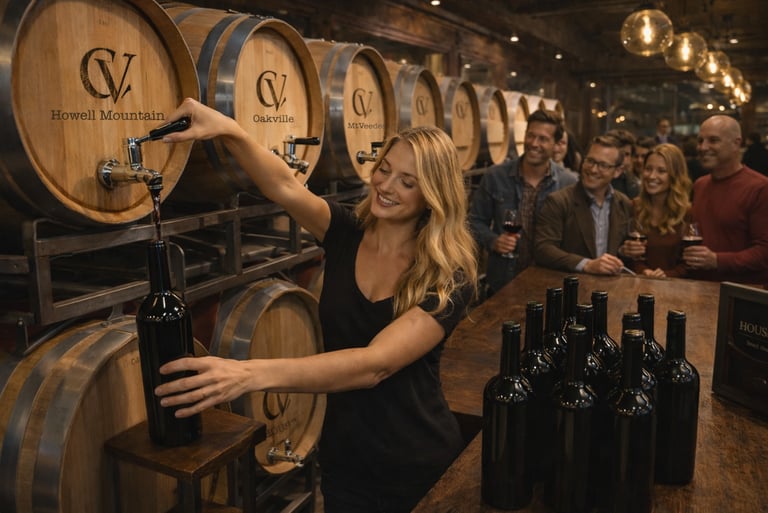
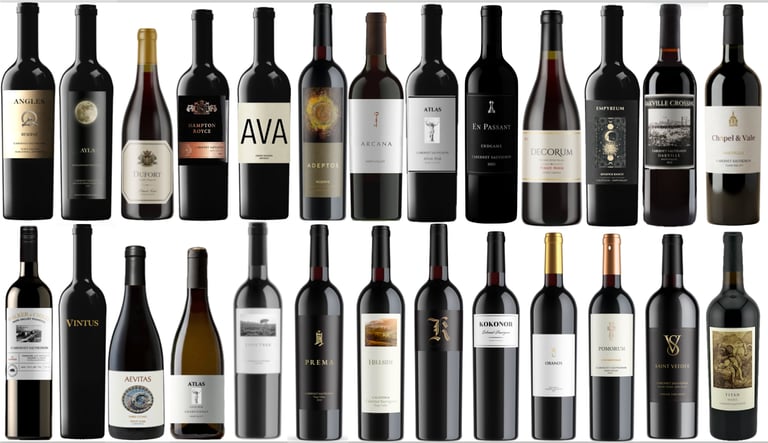
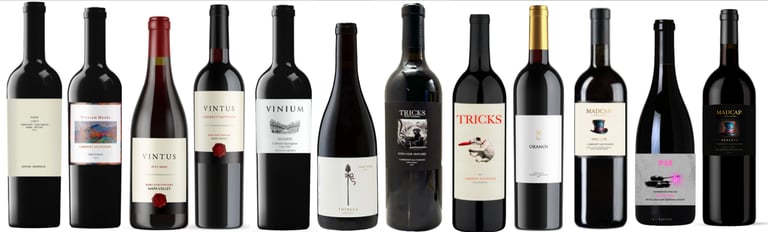
"Wines are poured directly from the Barrel, eliminating costly packaging, offering value over brand - with margins ranging from 80%-92%, kept fresh using proprietary technology."
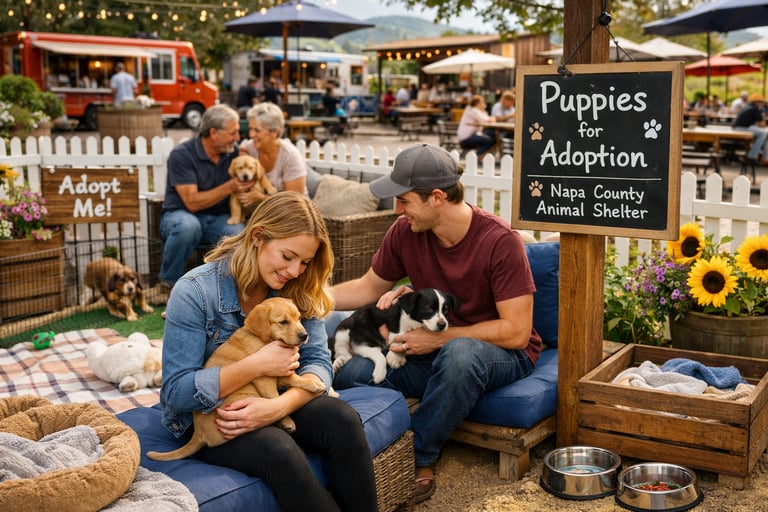
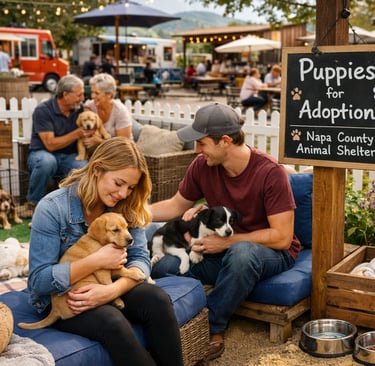
Partnerships with local non-profits, like Napa County Animal Shelter and Adoption Center, will further engage the community by offering free space for volunteers to help spread their missions.
Mr. Cardoza's 30+ years, selling, and now making wine, in the Napa Valley, allows him to source, super-premium offerings, from 90% of the 17 Napa Valley sub-appellations and AVAs, allows pricing to start at $1.00 per ounce filling vessels, from a .375ml to a Gallon jug to a 15 Liter Nebuchadnezzar at 507oz/$507
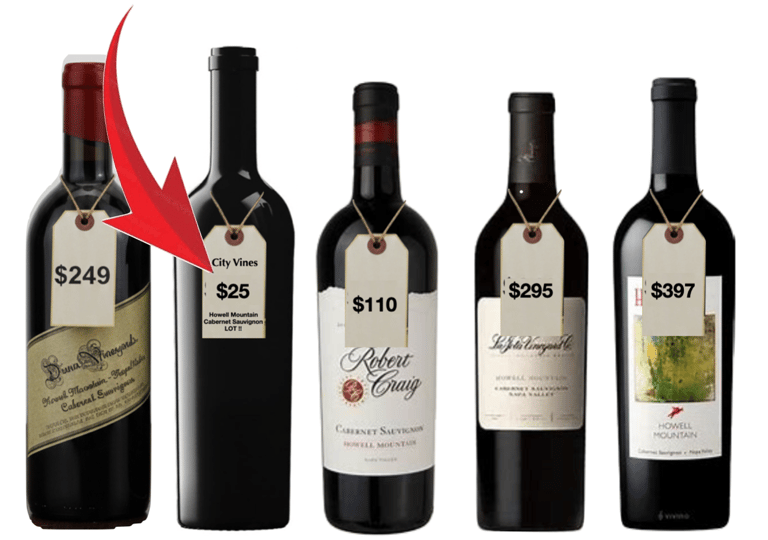
COMPARISON: Wines from the Howell Mountain AVA, for instance, can range from $80 to upwards of $500. Bypassing the land and production costs, the branding, bottling, storing, and advertising allow our Negociant to Consumer model to generate staggering margins, while offering the highest quality to our guests.
The wines above represent some of the brands Mr. Cardoza created to help Napa and Sonoma Valley wineries move their excess wines since 2020.
The Harvest Lane Project takes this philosophy to the next level, creating a space where "everybody wins".
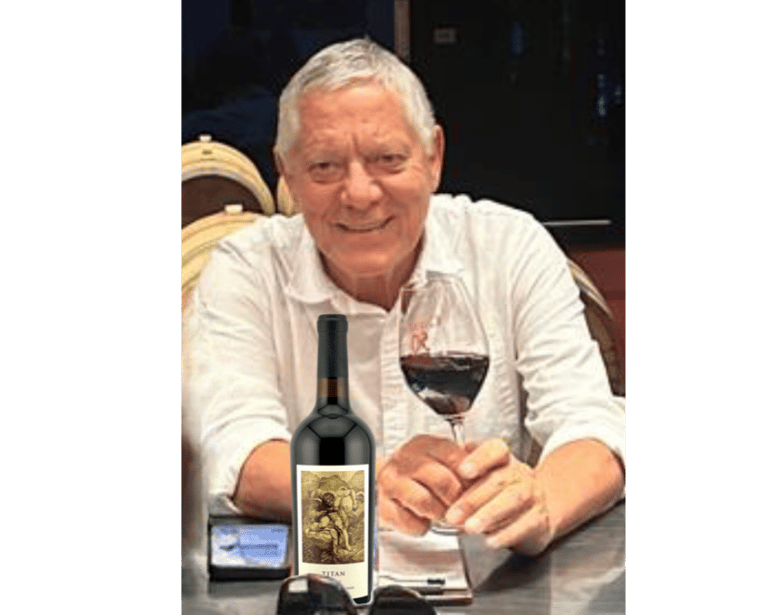
FOUNDER: Richard Cardoza
The Urban Winery: The economic engine that drives the financials... shatters the normal Napa winery model...Premium Napa Valley wines for $ 1.00 per ounce, by the glass - $6 for a 6oz Glass, and $25 for a 750ml bottle of Appellation Driven Napa Valley Cabernet Sauvignon...... with margins of 80%-92%.........................
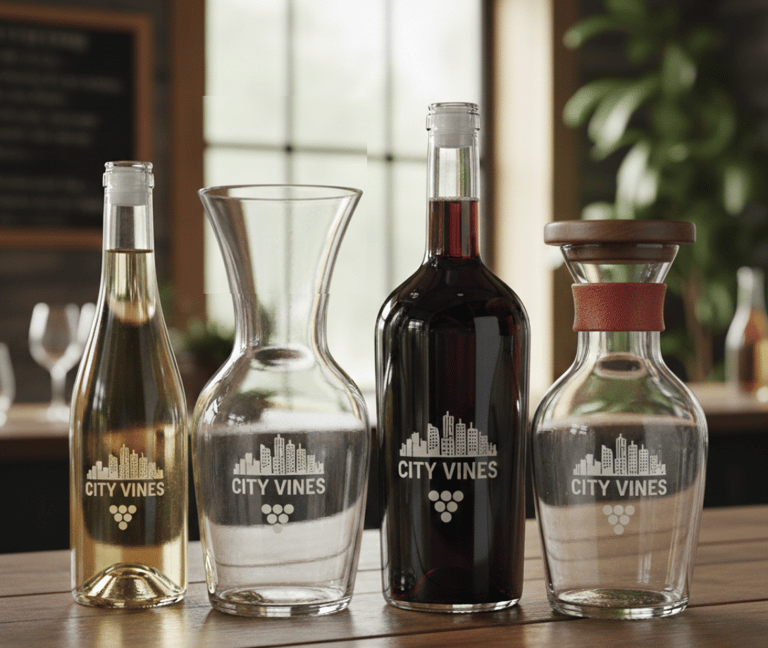
Branded wine vessels of all sizes will be an "add-on" purchase, and will be part of an "exchange" program where the refillable container can be brought back for an even exchange when refilled.
1. SUMMARY
"Harvest Lane is designed as the new 'Living Room of Napa.' It is a place where a glass of world-class Cabernet costs less than a latte, where small businesses find their footing, and where no member of our community goes hungry."
Harvest Lane is a high-yield, modular hospitality engine—a precision wine-retail model delivering institutional-grade returns behind the approachable facade of a premium neighborhood social park. It is built for Napan's to enjoy, with a Free "membership," a Napa County Residents and 2 guests can enjoy Napa Valley wines by the glass, for $1.00 per ounce, while tourists and other guests pay full price.
It was designed to disrupt the 'Elitism Wall' of the wine industry by re-engineering the cost of goods to create the next generation of consumers.
Harvest Lane creates a permanent community "3rd Space" that includes:
City Vines Urban Winery: A financial model that shatters the traditional winery DTC model, stripping COGs through a Circular Exchange, we provide the same juice at a 60% discount to the consumer while maintaining an 80% gross margin.
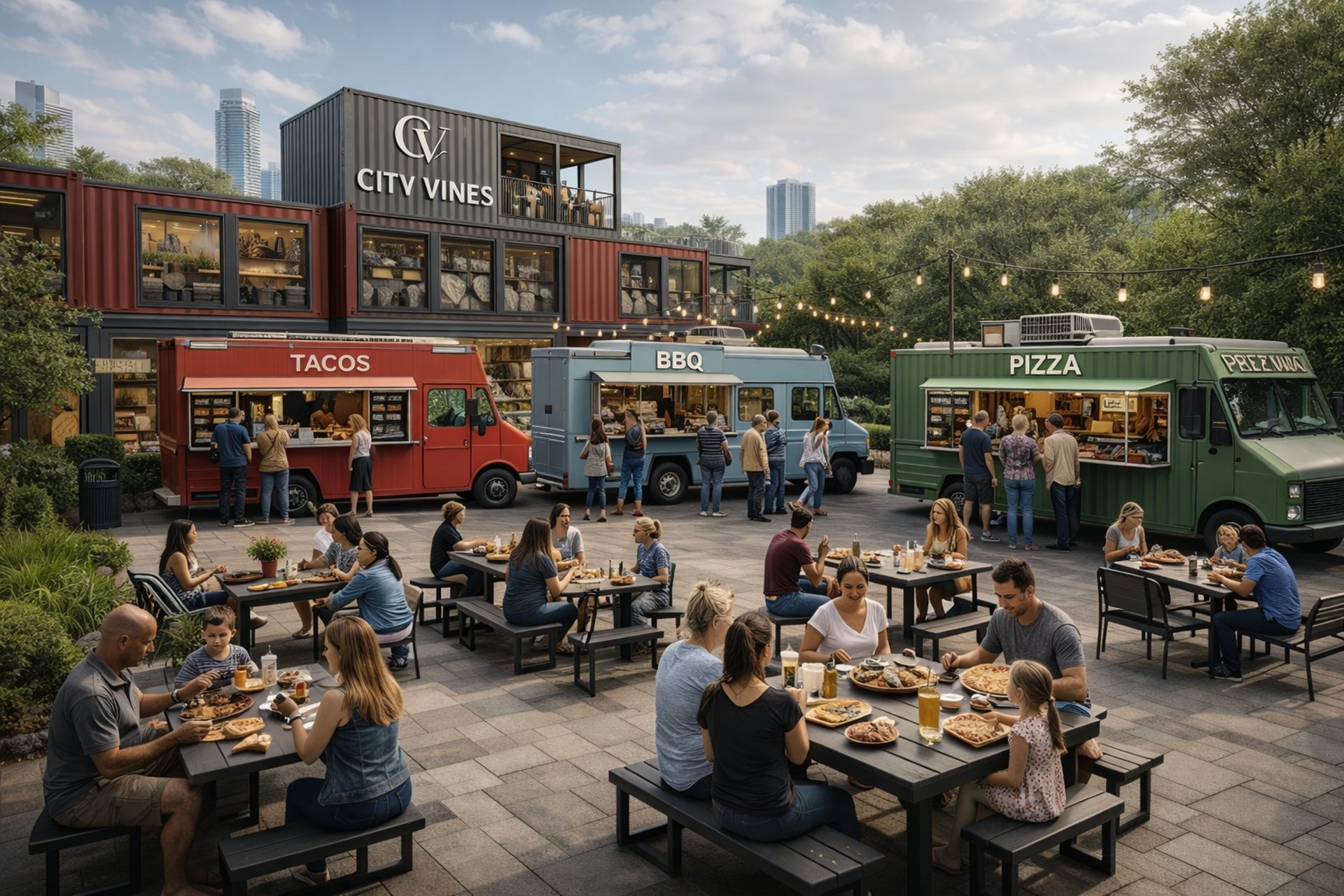
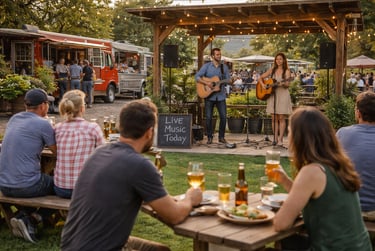
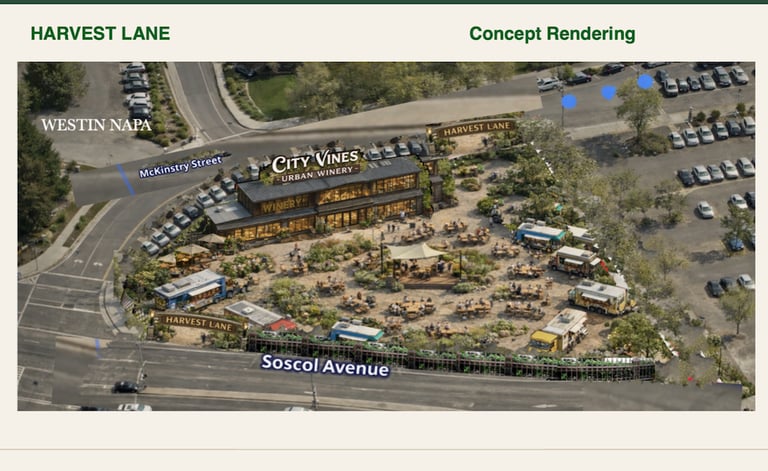
A Festive Food Truck Hub and Communal gathering park: Permanent electric hookups, for up to 8 curated Food Trucks, and a beautifully landscaped, urban park, complete with ADA Public Restrooms, park benches, bike racks, artists' tents, Non-Profit space, provides a comfortable space, diverse range of high-quality, affordable food options, drawing patrons without the need of marketing.
A Circular Exchange Program encourages guests to purchase premium, artistically branded "City Vines" glass bottles, which can be filled and consumed at home, and then return them for a sanitized, pre-filled replacement.
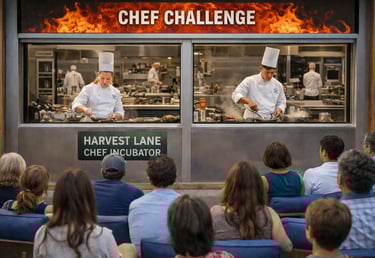
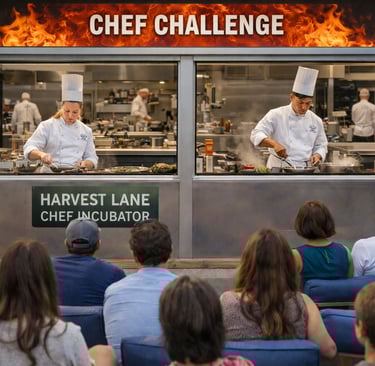
Commissary Kitchen: allows food trucks and other culinary vendors a central kitchen to work from, with a "Display Kitchen" capable of hosting community cooking classes, shows, and cooking competitions.
COMMUNITY IMPACT
Culinary Incubator: Commissary kitchen will subsidize a pop-up space for graduates of Culinary programs in the Valley to get an opportunity to run a business for a month at a time.
Non-Profit Alliance will partner with the Napa County Animal Shelter to have a puppy and kitty “meet and greet” space, for locals to sit with and help adoptable animals acclimate themselves to humans.
"Common Table" Initiative: A built-in social contract where high-quality surplus food from all vendors is gathered twice daily (after lunch and dinner shifts) and distributed directly to our neighbors in the nearby housing transition shelters and camps.
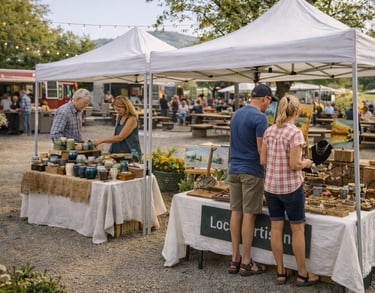
Community Anchor: We will dedicate and subsidize space for local “makers” to show their crafts each week. A fully wired stage for local musicians to plug in and play paid acoustic sets.
BY THE NUMBERS: KEY DEMOGRAPHIC INSIGHTS
Daily Commuter Exposure: 19,000+ Vehicles (Direct frontage visibility on Soscol Ave).
Immediate Residential Base: The population density within 1 mile, is 15,000+, with an average age of 39, and a median income of $78,000.
The "Walk Score" Edge: Strategically located to serve the "Carless Ecosystem" of residents who currently lack a local community "third space," the Downtown core, 1st & Main has a Walk Score of 98 -
THE VINE Public Transit Station is a short .3 mile walk from the property.
Non-Motorized Traffic: Direct access to the Vine Trail bike path and downtown foot traffic
Luxury Hotels: Within 1 mile of the property, the Luxury Hotel room inventory is 1,200-1,500 rooms, CURRENTLY AVERAGING 73% OCCUPANCY
The Academic Engine: 5,000+ Students/Staff at Napa Valley College (1.6 miles / 4-minute drive). Public Transit services the college every 30 minutes between Napa Valley College and the Soscol Gateway Transit Center.
The "Food Truck Park" atmosphere, offering 8,000 sq. ft. devoted to outdoor space, tables, and public restrooms. Locals and Tourists will feel equally at home.
REVENUE PILLARS: THE HIGH-VELOCITY ENGINE
The Subscription Floor: A target of 1,000 "Purity Loop" members in year 1 generates $600,000 in annual recurring revenue (ARR). This creates a high-certainty "cash floor" that covers fixed overhead regardless of daily foot traffic.
The Daily Social Loop: Capturing just 1% of the 19,000+ daily vehicles on Soscol Ave. A typical $35 transaction (glass, vessel, and fill) yields an industry-leading profit because our COGS is only $5.20.
VINIUM Ecosystem Upsell: Our proprietary 9.0L "Bag-in-Barrel" system serves as the ultimate subscription anchor, keeping premium wine fresh for 75 days and locking in long-term customer loyalty.
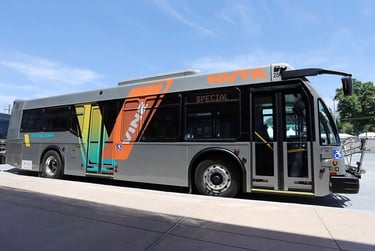
Vine Public Transportation runs every hour between Napa College to Calistoga.


Downtown Napa .5 miles by foot
15,000 residents within 1 mile
Oxbow market .3 mile
BUSINESS STYLE: The "Third Place" Evolution
Harvest Lane Culinary Village is not a development project; it is a proprietary hospitality ecosystem, engineered as a "Third Place"—a destination between home and work—that merges the high-margin mechanics of a world-class winery with the low-barrier accessibility of an urban park.
"Modern life is increasingly divided between the 'First Space' (home) and the 'Second Space' (work). However, the human need for a Third Space—a neutral, public ground for informal social interaction—has never been more critical. As remote work and digital isolation become the norm, people are actively seeking physical environments that offer a sense of belonging without the pressures of home or the office."
Harvest Lane as Social Infrastructure. "Harvest Lane Culinary Park is designed to be this essential anchor. Unlike a traditional restaurant where the experience ends at the bill, our Culinary Park is a 'living room for the community.' By prioritizing walkability and open-air social loops, we provide the 'bridging social capital' that 58% of Americans now say is the primary reason they feel connected to their neighbors. We aren't just selling food; we are providing the venue for the human connections that modern consumers now value above all else."
Constant, weekly activity offers a reason for going back; Artists, recording artists, Comedians, CIA school graduates offer fun, diverse opportunities for new business.
1. The Food Truck "Anchor" Strategy We do not view food trucks as mere tenants; they are our primary marketing engine.
Infrastructure: By providing permanent 50-amp electrical hookups, we eliminate the noise and pollution of generators, creating a premium "park" atmosphere.
The Commissary Advantage: The 2,400 sq. ft. onsite kitchen is the "stickiness" factor. It provides the legal prep space trucks need, keeping them on-site 365 days a year.
Cross-Pollination: A customer comes for a $15 plate, enjoys a $9 glass of Napa Cabernet, and goes home with 3 bottles of wine, at $25 per bottle. With COGS of $17, on the $81 sale, we capture high-margin beverage revenue while the trucks handle labor-intensive food preparation and sales.
3. The DTC "Digital Village" Our on-site physical presence feeds our off-site digital revenue.
The Recurring Floor: As established in our financial model, the 1,000-member Direct-to-Consumer club creates a $600,000+ annual revenue stream that is independent of daily weather or foot traffic.
4. Scalable Infrastructure (Modular Deployment) By utilizing refurbished shipping containers and modular steel for the City Vines we achieve:
Speed to Market: We can be operational in 12–14 months, significantly faster than traditional "stick-built" construction.
Depreciation Benefits: Modular assets can often be depreciated at an accelerated rate compared to permanent buildings, a detail that "smart money" impact investors will immediately appreciate.
THE PROBLEM
For years the Napa Valley wine industry has faced persistent overproduction and declining traditional demand, while doubling down on pricing models that increasingly exclude residents, leaving more than 100,000 local Napa Valley adults underserved by the region’s most important resource, wine tourism. The local restaurant industry’s price structures also inhibit many locals from dining out more than once per month.
The 21–40 demographic is fleeing wine for spirits and RTDs because traditional tasting rooms feel like a 'homework assignment.' By making wine an 'event' rather than a lifestyle, Napa has ceded the future market. High glass costs and three-tier distribution markups have made a daily glass of premium wine an economic impossibility, even for the average local.
This Luxe approach also affects local artisans, musicians, and food vendors, who find themselves without a space to drive their sales. Food Trucks operate on dimly lit streets with uneven sidewalks, no seating, or service, forcing customers to eat in their cars or take it home. Emerging entrepreneurs face high barriers to testing concepts. Local artists and nonprofits lack consistent platforms for engagement.
Food insecurity persists alongside daily food waste.
These challenges are interconnected—and require an integrated solution.
SOLUTIONS
Harvest Lane addresses these challenges through a single, coordinated operating model:
• Accessible wine pricing reconnects locals to Wine culture - Napan's enjoy "free club membership" with discounts of 50% less than tourists pay*. Discounts apply to themselves, and up to 2 guests. (*Discounts for Napan's are available for Wine and Beer by the glass, bottle or larger formats, DTC subscriptions, Merchandise and shipping. Does not include food trucks)
• A curated food truck destination elevates vendors and guest experience. Management will choose which trucks get residency and which rotate.
• A culinary test kitchen and residency program reduces startup risk for chefs
• Integrated nonprofit participation supports ongoing community engagement
• Local artists and makers gain visibility in a high-quality setting
• Daily food recovery reduces waste and supports those experiencing food insecurity
Each element reinforces the others, creating a system that is both socially impactful and economically viable.
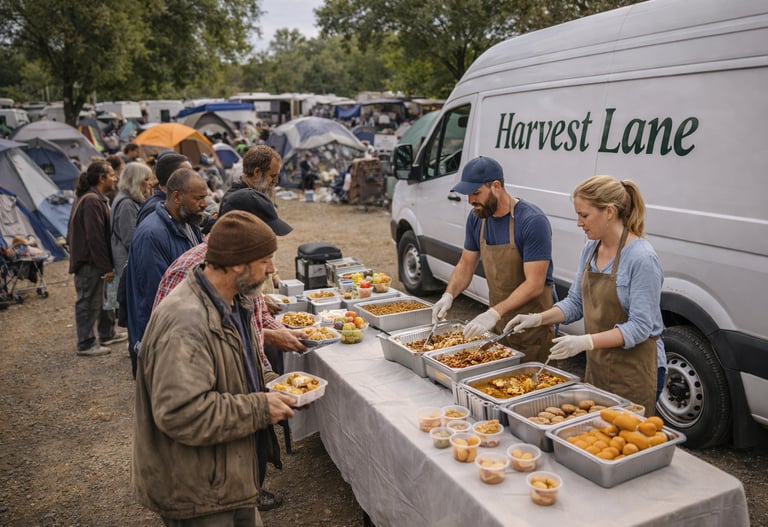
Feeding the hungry will be just one of the positive community efforts that Mr. Cardoza factors into any venture he plans for positive community impact.
Contact Richard Cardoza
Email richardcardozawine@gmail.com
Phone 508-951-0673
© 2025. All rights reserved.